Decode before you decide.
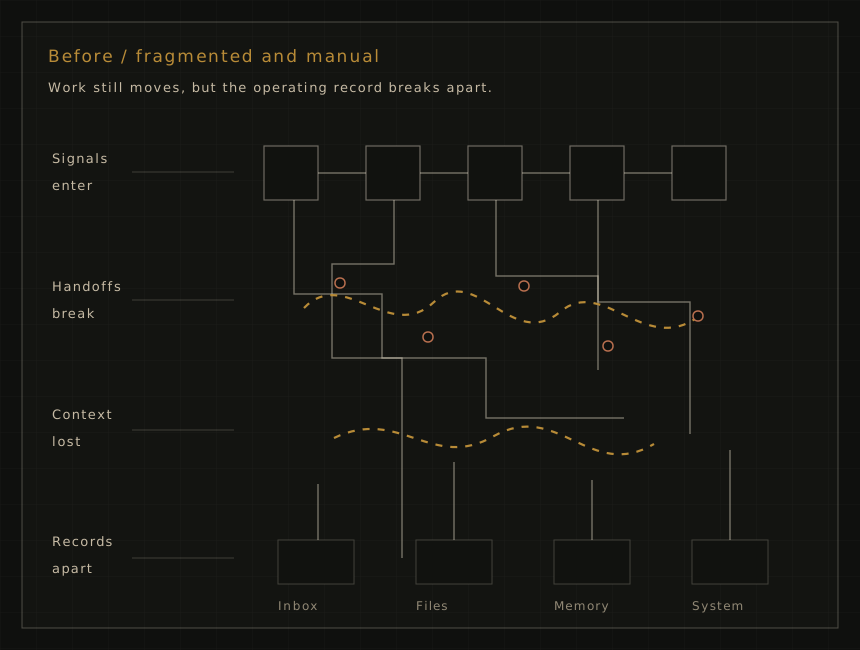
Most of the operating work I find inside growing businesses was never designed on purpose. A spreadsheet
that grew into the month-end close. A WhatsApp group that became the de-facto operating system. A finance
team that scaled with outlet count because nobody ever stopped to ask why.
The reflex move when someone walks into a business is to call this dysfunction. I do not read it that
way. Every one of those processes was rational at the moment it was created: there was a constraint, a
deadline, a person who left, a vendor who changed the rules. The shape stuck because nobody had time to
undo it. Nobody built a broken process on purpose.
That is why the first move on every engagement is the same. Sit with the team, not just the executives,
the people doing the actual work. Watch how things actually happen. Ask why this is the way it is. The
answer often points at the constraint that has to go before any new system will hold.
Walking in with a fix before you understand the why is how consulting decks die in PDF folders.
Give people their time back.
What I am usually looking at in those first weeks is people doing work that software can do.
A finance person reconciling thirteen outlets by hand every morning. An operations head copying data
from one platform into another to make a report nobody fully trusts. An owner waiting two weeks for last
month's margin numbers because the manual chain is too long.
The work to do is obvious once you can see it. Take the four hours per day of keystroke work and run it
overnight. Make the owner's morning start on yesterday's data instead of last month's. Free the finance
team from data entry so they can do the work an accountant should actually do: exception handling,
analysis, the judgment work.
This is the operating test for me, and it is the part most operating decks skip. The output is not
"better systems." The output is people getting their evenings back. Owners reading their business in
real time. Teams that do not grow linearly with transaction volume because the software is doing the
bookkeeping.
Build it so I can leave.
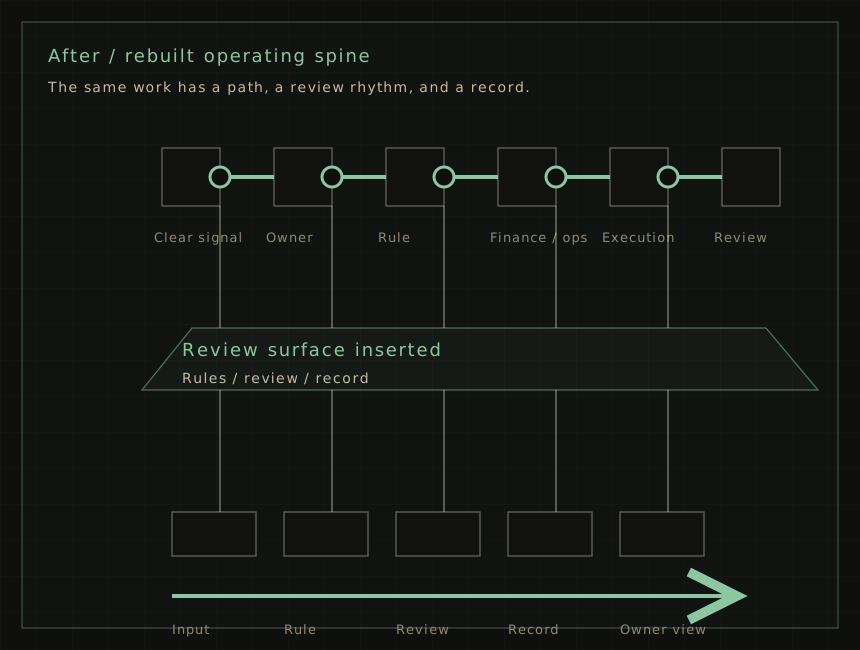
The design constraint on every system I build is that the client team runs it without me.
That is not a marketing line. It is how the system has to be architected. The flows have to be observable
to the team, not to me. The exception paths have to land in their inboxes, not mine. The next outlet has
to be configurable by them, not by me. The system has to grow past the operator. That is how you know the
work was actually done.
This is the part that distinguishes the work from a consulting engagement. A consultant ships a
recommendation; the client runs it. I ship a working system; the client owns it.
The reason is permanence. Most operating improvements revert, because the people doing the
work were not trained on the new process. If the team is not running it by the time I step back, it did
not transfer.
A note on the broader market.
The work I just described is not a contrarian view. It is the model Palantir's forward-deployed engineers
built around years ago, and the model Anthropic and OpenAI have both moved towards in 2025-26 through
their private-equity-backed deployment ventures. Software alone does not create value inside complex
operations. The value comes from making the work legible first, then letting the system reflect reality,
then training the people doing the work to run it.
The market is now converging on what most senior operators have known the whole time: this work is not a
software problem. It is a translation problem between how an organisation actually runs and what software
needs to do its job.
What that means in practice.
If your business is at USD 5-50M revenue and you have outgrown what off-the-shelf software or your
internal team can handle, the work I do is sit in your business for a week, decode it, ship the first
system that gives a person their time back, and design the rest so your team can run it after I am done.
Not slide decks. Working systems. People doing less of the work software should be doing.
Book a 30-min call